The baggage belt turns, slows down, and eventually only one certainty remains: your suitcase is not coming. Or you step off the train and realise on the platform that your travel bag is still in the carriage. Losing luggage is one of the most frustrating experiences when travelling – and it happens more often than most people think.
If you are searching for "luggage lost at the airport" or "baggage gone – what to do", you will find the key steps here. You will also learn how the GLOBALBACK identification number (GBID) helps an honest finder return your suitcase quickly.
1 Luggage lost – the first steps
If your baggage disappears at the airport, your first stop is your airline's lost-and-found desk. There you file a loss report and receive a reference number. Note down your flight details, any stopovers and an exact description of the suitcase, because you will be asked for all of it.
If a bag stays behind on a train, a bus or in a hotel, contact the lost-property service of the operator or the property in question. The more precisely you can describe the item, and the faster you react, the better your chances of getting it back.
2 The security risk of classic luggage tags
Many travellers write their name, phone number and full address on their luggage tag. It is well meant, but it can become a problem: an openly readable address tag tells anyone who sees it that this person is away travelling and their home is probably empty. At a busy airport, that is information you would rather not hand to strangers.
At the same time, an honest finder needs some way of reaching you. With no marking at all, an unclaimed suitcase ends up in a lost-property office at best – and stays untraceable at worst. So what is needed is a solution that lets the finder reach you without exposing your private details.
3 The solution: a GBID on your luggage
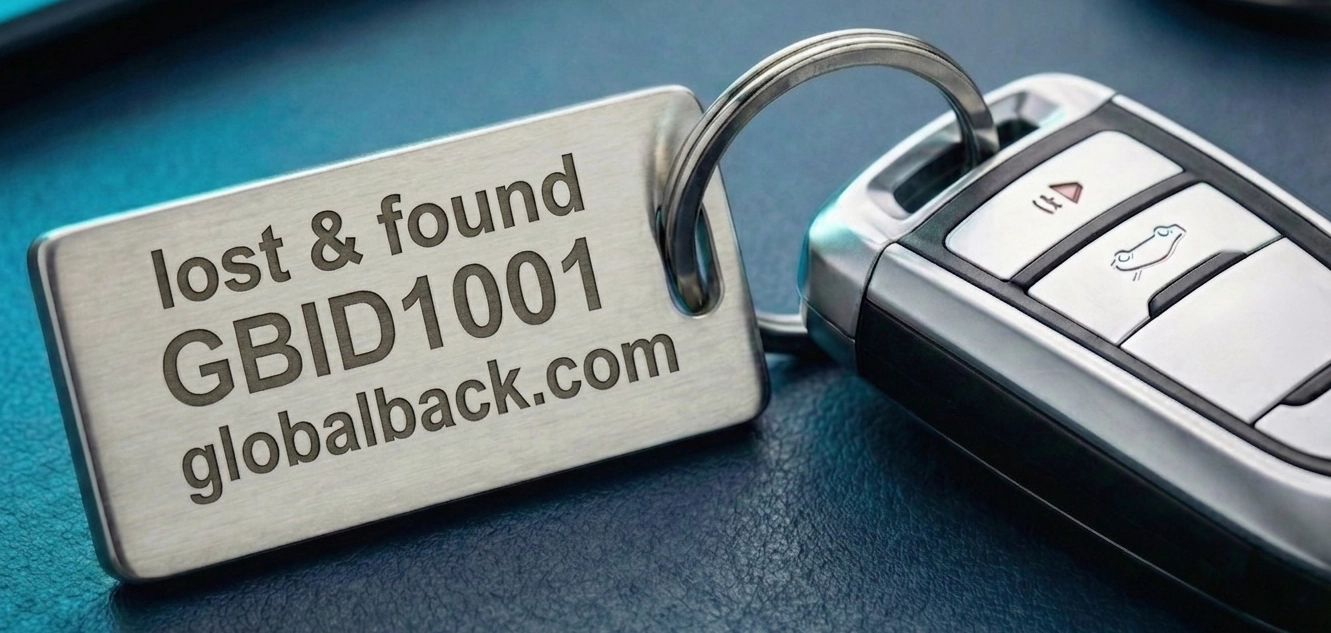
The GLOBALBACK identification number (GBID) is a globally unique number that you attach to a suitcase, travel bag or backpack as a sturdy tag. The finder – whether airport staff, train personnel, a taxi driver or a hotel employee – immediately recognises that this item is marked and can be returned. Your personal data stays completely hidden.
How the return works
The finder enters the GBID on the GLOBALBACK home page or scans a QR code if you use one – no app, no registration. Through a contact form they send you a message, which reaches you by email. You decide whether and how to respond, and your contact details stay invisible to them.
4 The time advantage with missing baggage
With misrouted air baggage in particular, every hour counts. An attentive employee who finds a marked suitcase has an immediate way to inform the owner. In the best case you already know your suitcase has been found while the airline's own search is still running.
That head start is valuable: the sooner contact is made, the more smoothly the return can be organised – and the less often a misplaced suitcase turns into a permanent loss.
5 Why describing your suitcase matters
At the airport, with a railway operator or at a lost-property office, you will always be asked to describe your suitcase as precisely as possible. Brand, colour, size and distinguishing features such as stickers, straps or scratches all help to identify your item. It is worth putting these details together calmly before you travel, so you do not have to think hard in a stressful moment.
A plain, single-colour suitcase with no features is harder to recognise than one with a clear marking. A clearly visible GBID on the handle not only makes your suitcase identifiable, it also signals to an honest finder that it can be returned.
6 Suitable for every kind of travel
Whether you fly, take the train, go on a cruise, travel by coach or by car: wherever luggage leaves its owner's sight – at check-in, in a luggage compartment, at a hotel reception or on a bus – a marking can make the difference. School bags, sports bags and instrument cases can be protected in exactly the same way. The principle is always the same: visible to the finder, protected for you.
7 Common questions about lost luggage
How long does it take for lost air baggage to come back?
In many cases misrouted baggage reappears within a few days and is delivered on. Only when a suitcase remains untraceable for a longer period is it officially considered lost. An additional marking increases the chance that an honest finder gets in touch independently of the airline process.
What is better than an address tag?
A GBID has a clear advantage over the classic address tag: it enables contact without revealing your name and address. That way you combine findability with privacy.
Can I mark several pieces of luggage?
Yes. You can give every item its own GBID – practical if you travel with several suitcases or as a family.
Conclusion: safe travel starts at the baggage belt
A lost suitcase can only be returned quickly if an honest finder has a way to reach you. A GBID on your luggage creates exactly that – visible to the finder, protected for you, with no readable address.
The solution is here – you just have to use it.