You reach into your pocket, feel nothing, and your stomach drops: your keys are gone. Few everyday losses cause panic this quickly – because a single ring often holds your front door, your flat, your car, your mailbox and sometimes even your office.
If you are searching for "lost keys – what to do", you are in the right place. This page explains which steps really matter, what costs you may face, and how the GLOBALBACK identification number (GBID) helps an honest finder reach you quickly.
1 Lost your keys – what to do first
In the first few minutes, a clear head helps more than panic. Retrace your last stops: where were you, and when did you last hold the keys? Very often they are still at the café, in a shopping trolley, at the gym, or have simply slipped between the sofa cushions.
If the search turns up nothing, consider which locks the key opens and whether a stranger could take advantage. With a plain front-door key and no address attached, the risk is low. It becomes more serious if an ID card, an address tag or a business card hangs on the same ring – then a finder may know immediately which door the key fits. For that reason alone: never write your address on your keyring.
2 Why losing keys can become expensive
Many people underestimate the costs a lost key can trigger. It is rarely about the piece of metal itself.
- Car keys: Modern vehicle keys with an immobiliser or keyless-go function have to be re-coded and programmed. Depending on the make and model, this can quickly run into several hundred or even a few thousand in currency.
- Master key systems in apartment buildings: If your key belongs to a central locking system, the entire system may need replacing in the worst case – and those costs are often charged to whoever lost the key.
- Office and building keys: With commercial locking systems the consequences are often even greater, because many doors and users are affected.
These potential costs are the main reason why the quick return of a found key is so valuable. The sooner your key comes back, the more likely you avoid an expensive replacement altogether.
3 The real problem: a found key says nothing
Picture the situation from the finder's point of view. Someone spots a set of keys on the pavement or in a café. The honest wish to return them is there – but how? A key reveals nothing about its owner. No name, no phone number, no way to make contact.
And that is a good thing: if your name and address were on it, every finder would know exactly which door those keys open – a serious security risk. But it leaves the honest finder helpless. The keys often end up at a lost-property office eventually, and sometimes nowhere at all. This is exactly the gap that GLOBALBACK closes.
4 The solution: a GBID on your keyring
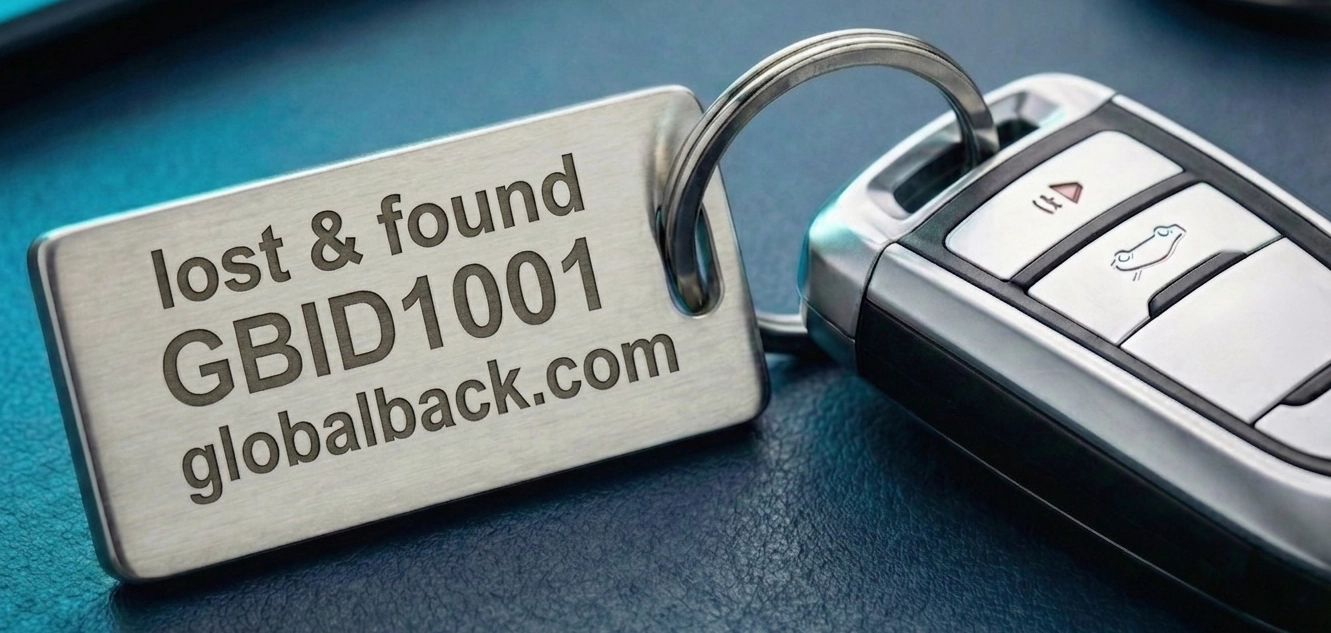
The GLOBALBACK identification number (GBID) is a globally unique number that you attach to your keyring as a sturdy tag. The finder sees straight away that these keys are marked and can be returned – without a single private detail about you becoming visible. Neither your name, nor your address, nor the lock they belong to can be identified.
How the return works – no app needed
The finder simply enters the GBID on the GLOBALBACK home page, or scans a QR code if you use one on your tag. No app and no user account are required. They can then send you a message through a contact form. It reaches you by email, and you decide whether and how to respond.
Your data stays protected
Your contact details are not visible to the finder. If you wish, you can additionally store a phone number for finders with each GBID in your GLOBALBACK account – entirely optional. That way you always stay in control of what you share.
5 The time factor: often faster than a lost-property office
The greatest advantage of a marked item is speed. A finder who sees a clear way to return something usually acts immediately – they do not have to carry the keys around for days or make a trip to the nearest lost-property office. In the best case, the first message reaches you before you even notice the loss.
That speed matters especially with keys. As long as they are already on their way back to you, there is often no need to call an emergency locksmith or replace a locking system.
6 Common questions about lost keys
Should I report lost keys to the police?
A simple loss with no sign of a break-in is usually a matter for a lost-property office rather than the police. It is different if the keys were stolen, or if you suspect someone knows your address – then reporting it can make sense.
When does a locking system have to be replaced?
That depends on the individual case, in particular on whether the key can be linked to a specific flat or address. Your landlord or property manager decides whether a replacement is necessary. This is precisely why it is so valuable when keys find their way back to you quickly and without a readable address.
Does a GBID also help with car or bicycle keys?
Yes. A GBID can be attached to virtually any keyring – whether it holds house, car or bicycle keys. It marks the set as a whole and makes contact by an honest finder possible.
Conclusion: prevention is the best protection against the shock
You only get lost keys back quickly if an honest finder has a way to reach the owner at all. A GBID on your keyring creates exactly that – visible to the finder, protected for you, and without revealing your address to strangers.
The solution is here – you just have to use it.